Who this trip is for
Most Hurghada excursions sell speed and spectacle. This one doesn't. You spend the day in two walled monasteries in the mountains of the Eastern Desert, where monks have lived since the early centuries of Christianity. Their churches have wall paintings that have been restored, and every guided visit is partly a conversation. It suits Christian travellers making a pilgrimage, people interested in early Christianity and the desert fathers, and anyone who has done the boats and wants a different kind of day.
It does not suit children who need action, anyone expecting a desert safari (there are no quads or camels), or people who find six hours of driving boring for two visits. The coast road north is pleasant for the first hour. After Ras Gharib it is mostly oil fields and wind turbines until Zafarana.
St Anthony's: the larger monastery
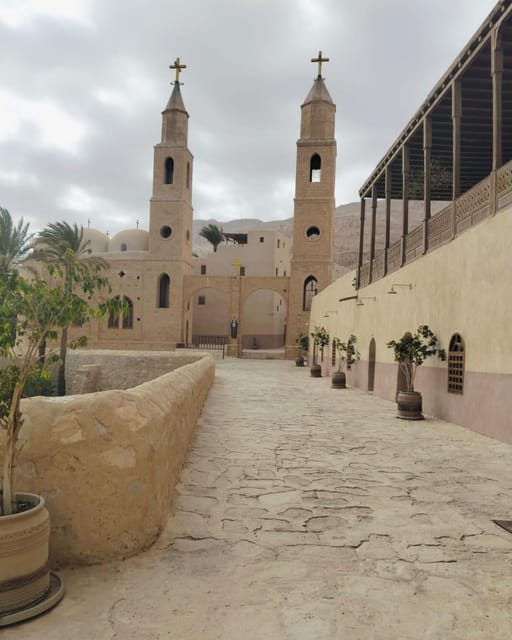
St Anthony's is the bigger of the two and feels like a small walled village, with churches, gardens and monks' cells. Operators date its founding to the 4th century, soon after the death of St Anthony, the hermit usually called the father of Christian monasticism. On the group tour sold online, the explanation comes from a monk. The visit is about the place and the life lived there, not just the paintings. Above the monastery, a path climbs the cliff to the cave where Anthony lived. It is a steep climb and not part of the standard day tour.
St Paul's: the cave church
St Paul's is smaller and lies on the other side of the same mountain range. Its heart is the cave church built around the cave of St Paul the Hermit, with murals, altars and old candelabra. It is darker, cooler and more intimate than St Anthony's. If the schedule allows, sit for a few minutes.
What to wear and what to bring
These are active religious communities, not museums. Cover shoulders and knees, and take off hats and sunglasses in the churches. Ask before you photograph monks or services. Bring:
- Food and water. Meals are not included on the online tour. Order a breakfast box and a packed lunch from your hotel the evening before.
- Cash in Egyptian pounds, for the monastery bookshops and for donations if you wish to leave one.
- Passport or ID, as the operator requests.
- Comfortable shoes for stone steps and uneven floors.
How it compares with Luxor and Cairo days
The monastery day is gentler than the other long trips from Hurghada. Pickup is around 06:30 rather than 04:30 or 02:00, the road is about three hours instead of four to six, and the published itinerary has no shopping stop. Guests in El Gouna are already on the right road north and lose less time. The visits themselves are short walks on stone floors, partly indoors. You will still be tired by the evening, but probably less than after Luxor or Cairo. If the Coptic story interests you, combine it with a Cairo trip that includes the Hanging Church and Abu Serga in Old Cairo. Some private Cairo itineraries from Hurghada add them.
How booking works
There is currently one listing for this trip on the big platforms: a group van tour with an English-speaking guide, monastery visits and hotel pickup in Hurghada. Pickups from Makadi, Sahl Hasheesh, El Gouna, Soma Bay and Safaga are an add-on. The start time depends on your hotel, around 06:30. A few local agencies specialise in Coptic heritage trips and may combine the monasteries with churches in Cairo. If you book locally, ask for the guide's language and confirm whether entry to both monasteries is included before paying.